Bigger queens, better queens … and easier queens
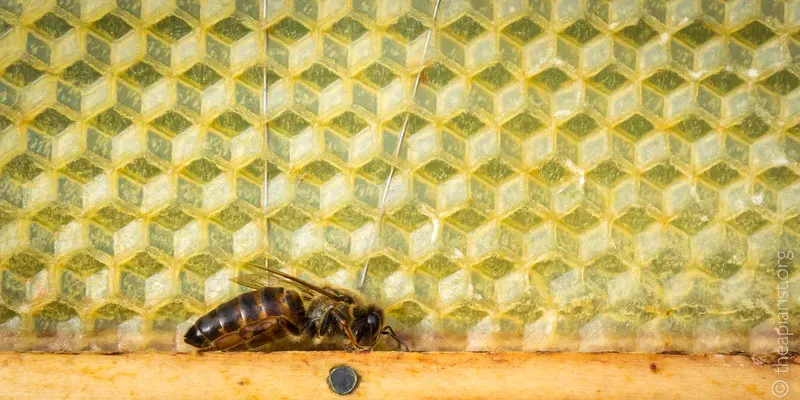
About 250 years ago A.G. Schirach, a pastor in Kleinbautzen, Eastern Germany, showed it was possible to rear new queens from larvae laid in worker cells.
François Huber described Shirach's “conversion of a common worm into a royal one” when he repeated the experiments a few years later.
In 1794, Huber published his studies. The addition of eggs and young larvae to a queenless colony resulted in them provisioning the “worms with a thick bed of jelly”. Huber then removed the initial 'worms' (larvae) and replaced them with two day old worker larvae, which were subsequently reared into queens.
Many beekeepers will recognise the two key features in that paragraph that characterise many current queen rearing strategies:
- Use of a queenless colony to rear new queen cells; the cells are being reared under the emergency response.
- Grafting — the manual transfer of beekeeper-selected larvae — from a donor colony into cells in a queenless cell-raising colony {{1}}.
Since then, for ~230 years, nothing has really changed.
In the latter half of the 19th Century G.M. Doolittle popularised queen rearing by grafting directly into wax cups. He initially used natural 'play cups', and later described the creation of cups from warmed wax moulded around shaped dowels.
This use of wax cups wasn't Doolittle's invention, but it became known — and still is — as the Doolittle method {{2}}.
Laidlaw & Eckert discuss the history of queen rearing in the introduction to their, appropriately titled, book Queen Rearing (1962).
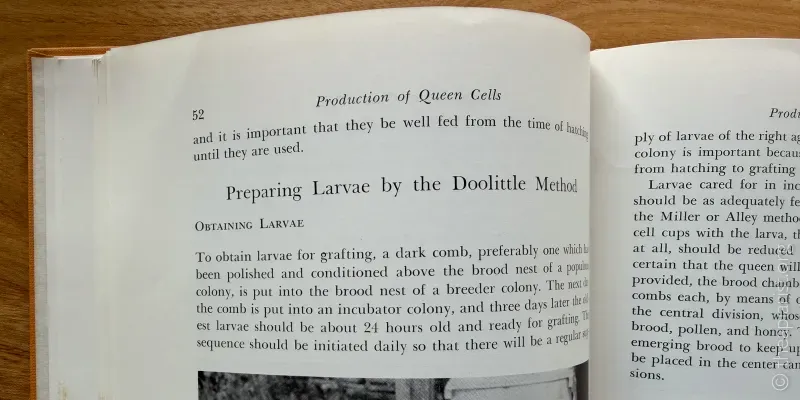
The 'state of the art' methods they go on to describe — remember, from ~60 years ago — are essentially identical to those currently used to rear the vast majority of queens {{3}}:
- Manual selection and grafting of day-old larvae into artificial queen cups (often now plastic, rather than wax).
- Presentation of the grafted larvae to a queenless cell-raising colony where they are reared under the emergency response.
- Use of nucs or mini-nucs for queen mating.
But, although the methods haven't changed in 60+ years, we've learnt a lot in the intervening period about how the colony naturally rears new queens.
It's quite an interesting story … but it's ignored by most beekeepers when rearing queens 😞.
Science, and the 'art of the possible'
Honey bees are fascinating insects. They are studied by scientists interested in the evolution of eusocial behaviour, or waggle-dance communication, or pheromones.
Or, for that matter, how larvae are selected by the colony when rearing new queens.
This is arguably the most important decision the colony makes.
If they get it wrong, the swarmed colony will perish … or, simply prolonging the inevitable, not thrive, and fail to reproduce (swarm) the following year.
Scientists can only meaningfully study events that are reproducible. This allows experiments to be repeated to provide statistical rigour to the conclusions.
Queens are reared in response to three different conditions:
- Queenlessness — the emergency response
- A failing, ageing, or substandard queen — the supersedure response
- Overcrowding, or a reduction in the queen retinue pheromone — the swarming response
Whilst you can induce overcrowding, or use geriatric queens, scientists cannot reproducibly create conditions for swarming or supersedure.
Doing so is all a bit hit-and-miss.
Therefore, in studies of queen rearing, scientists rely upon the induction of the emergency response.
The great thing about the emergency response is that it works … every time.
And, in studies of queens reared under the emergency response, we now know that the colony is extremely selective in the larvae they choose to rear new queens from.
Their future depends upon it, so it's not surprising that they're picky.
Unfortunately, beekeepers manually selecting larvae for grafting are unable to discriminate using any of the criteria used by the bees.
Inevitably this means that some larvae beekeepers choose would have been overlooked or rejected by a colony rearing a new queen.
But, all is not lost …
Most queens are reared by beekeepers under the emergency response. Since that is also how scientists have also studied how queens are reared, the scientific results are very relevant to practical beekeeping.
Knowing what the bees do should allow beekeepers to rear better queens.
Trust the bees
In this post, I'm going to briefly outline the current understanding of the science relevant to queen rearing, and then describe two practical approaches to exploit this to rear queens.
Conveniently — and importantly — one of these approaches is suitable for those with no previous queen rearing experience, and requires no additional equipment.
It is therefore appropriate for relatively inexperienced beekeepers who are interested in rearing a few queens for their own use, or to share with friends.
Access to this post requires a paid subscription to The Apiarist. The post is 6,000+ words long, and took several hours to write and illustrate. None of it is AI-generated 'slop'. Paying subscribers (sponsors) keep the lights on here, they keep the servers backed up, and they pay for the coffee I drink when writing.
A paid subscription costs about the same as a large cappuccino a month, or less annually, and gives you access to an archive of ~700 posts, a new article every Friday, and irregular Beemusings posts.
The second method is really a logical extension of the first, requiring a little specialised equipment, and involving some slightly more advanced hive manipulations. Nevertheless, it should be well within the capabilities of beekeepers with 2–3 years of practical experience.