A palace fit for a queen
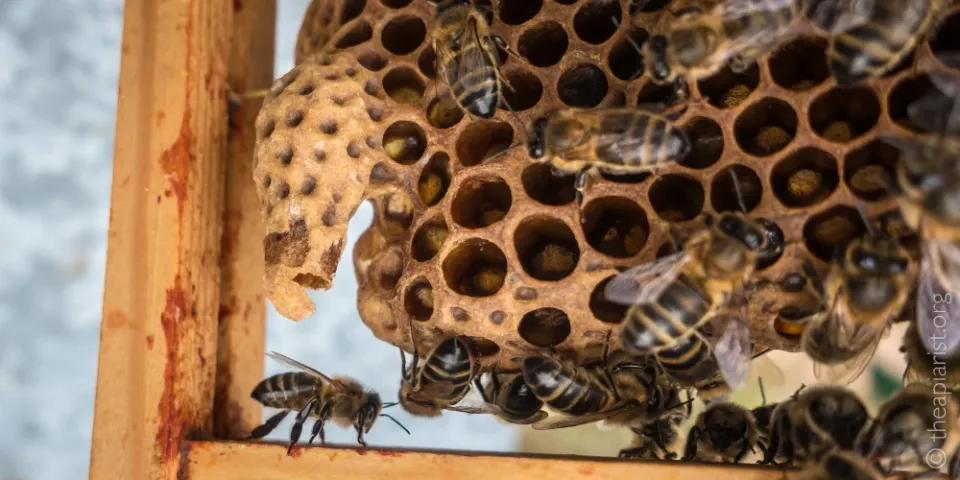
In terms of good beekeeping advice, Ted Hooper's book (Guide to Bees and Honey) takes some beating. It was first published almost three decades ago. My copy, the fourth edition, dates back to 2008. The illustrations (line drawings, or B&W images) make it look dated, but the text remains relevant and is better than many of the 'up-to-date' publications.
My copy is well-thumbed, has been read cover-to-cover several times, and is still regularly used to check some detail I've either forgotten, or (more likely) never knew in the first place.
Most recently, I was looking up Hooper's advice on choosing which queen cells to keep and which to cull.
I still remember being amazed when I first read this section, as he describes opening and resealing a cell to check it's occupied:
If you wish, you can gently open up a flap on its side towards the base [and] take a look at the queen pupa and then push the flap back and carefully repair the cut.
I've never done this, at least not successfully {{1}}.
Hooper favoured heavily sculpted cells because he considered those with smooth walls indicated that there was “usually something wrong with [the developing pupa]”.
That's one interpretation … but I can think of several others.
I've always had the impression that cells become more sculpted over time, as they receive extra attention from the workers {{2}}.
However, if Hooper is right, it begs the question “Which comes first? The dud pupa, or the smooth cell?”
Is the cell smooth because the bees can recognise a substandard developing pupa (so ignoring it), or is the pupa dud because the cell is smooth?
For example, contamination of the wax might reduce the attention given to the cell by workers, or the absence of a critical cohort of 'cell-sculptors' (entirely hypothetical … or are they?) in the hive might leave the cell unattended, leading to failure of the developing queen.
The art of the possible
Is this testable?
Of course, it is.
Let's assume you start with larvae grafted into plastic queen cups (like JzBz, Nicot, or your own 3D printed cups).
All (!) you would then need to do was swap smooth and sculpted queen cells just before pupation starts i.e. immediately prior to the cell being sealed. At this point, the larva remains floating in a bed of royal jelly within the plastic cup, with the wax of the queen cell being extended 'below' it, ready to be occupied when the larva reorientates vertically at the onset of pupation.
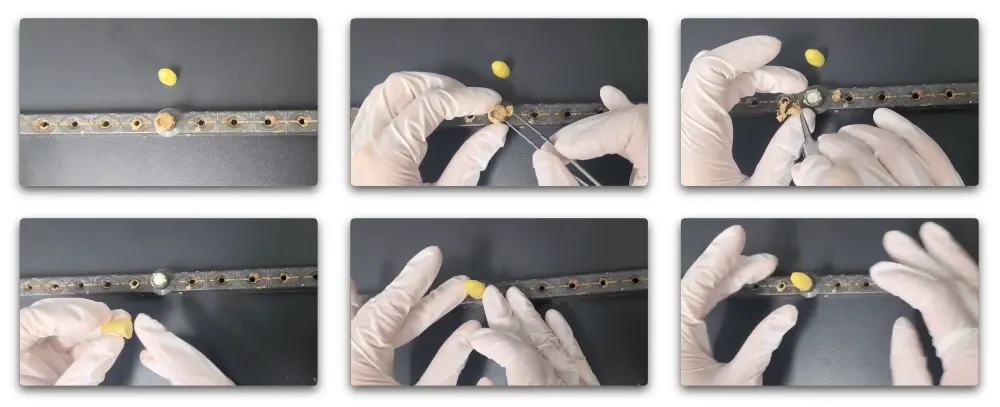
As far as I know, this hasn't been done {{3}}, so we don't really understand why some cells are sculpted and some are not.
However, in a recent paper published in the leading journal Nature, scientists have used exactly this technique to show that the wax the queen cell is constructed from has a profound impact on the development of the queen (Fang et al., 2026).
In a nutshell … queens reared in cells made from queen cell wax are bigger than queens reared in cells made from worker wax.
This suggests that there's something rather special about queen cell wax.
And there is … but it turns out that not only is the wax different, but the workers that construct the cells are also different, in terms of age, behaviour, physiology, and genetics.
Those 'cell-sculptors' are not so hypothetical after all 😉.
This is an extraordinary piece of science, and provides novel insights into the construction and role of the cell in queen development.
Why not become a sponsor?
Sponsors receive weekly posts on bees and beekeeping, many of which are for sponsors only. This post is for sponsors. Sponsorship costs less than a coffee and a slice of flapjack a month … with discounts for an annual membership.
The paper is — to put it mildly — data rich.
The study took 6 years and has 20 authors. Many beekeepers won't have access to it, and (of those that do) most won't read it, and/or won't have the science background to understand it.
That's a pity as the research is fascinating and remarkably complete i.e. it doesn't leave too many unanswered questions {{4}}.
In addition, I think there are implications for beekeepers interested in queen rearing, both in terms of the hive and the bees that populate it.
Finally, I think this work shows how little we really understand of this fascinating and exceptionally well-studied insect.