Better pollen sub patties
At this time of the year I often write about New Year's Resolutions.
In 2023, I suggested a range of possibilities that would (or at least should) improve your beekeeping. Last year, rather than focus on specific goals, I defined them in terms of happiness-, goal-, pride- or profit-based. It's a slightly more generic way to think about things, but it probably doesn't increase the likelihood of the resolution being kept.
Research shows that only about 12% of New Year's Resolutions are kept (citations in those last two links), and those I made — or at least vaguely hinted at — in my 2025 post were largely abandoned by late spring 😞.
Of course, profit-based resolutions and beekeeping are clearly nonsensical.
What was I thinking?
I've therefore resolved this year to not make any New Year's Resolutions.
This means that there's about an 88% chance I'll successfully do something despite not resolving to do so 😉.

Unless you took my advice and are holidaying in New Zealand (or are lucky enough to live there) you are probably still 2–3 months away from any practical beekeeping.
That doesn't mean that there's nothing to do, it just means that you've got time in hand, so can procrastinate for another week or two.
Or, like me, you can use a few dry and calm winter days (fuelled by a surfeit of mince pies) to rationalise a huge pile of supers for the season ahead. Every box now contains 9 frames, no brace comb, no wax moth damage, and no broken lugs.
'Feeling smug' doesn't come close 😉.
If you want to avoid the AI 'slop' that increasingly contaminates beekeeping websites then please consider supporting The Apiarist. Sponsors ensure the continued existence of the site, and receive regular sponsor-only content. ChatGPT has never opened a hive or made a pollen patty, so why trust its judgement when seeking information or entertainment on the science, art, and practice of sustainable beekeeping?
Educate yourself
And, on the winter days that were neither dry nor calm, I've read up about something I've attempted before, but was unhappy with, in preparation for trying something different this year.
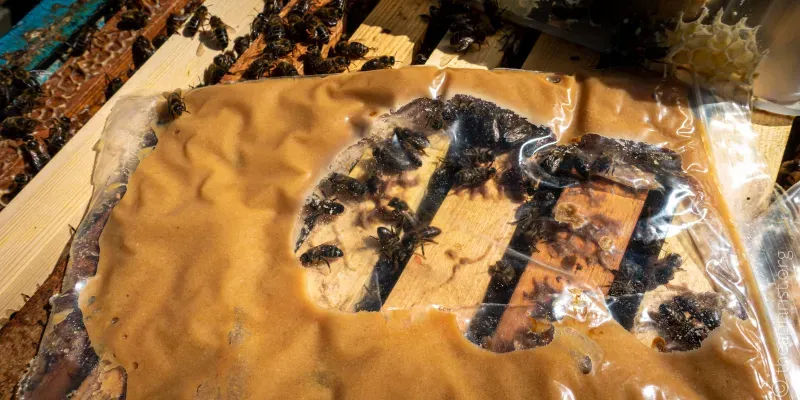
The thing I 'tried and (sort of) failed' with in the past is using pollen substitute (protein) patties to boost early season colony expansion … and that's what I'm going to discuss today.
Specifically, I'm going to discuss how the protein content — by which I mean the source of the protein, not the percentage of protein — of these patties influences hypopharyngeal gland development in nurse bees … and why that's important.
This reading was prompted by two things:
- A realisation that I'd exhausted my stack of pre-prepared, frozen, pollen sub patties, and would need to make more in the next month or so.
- Some recent science showing that certain protein sources were markedly better than brewer's yeast or soybean flour, which are standard components in a good deal of pollen sub recipes.
But I'm getting ahead of myself … let's start with the basics.
What is a pollen sub patty, when and why might you use it, and how do you know whether it was beneficial?
And — most importantly — what does the science tell us about making better pollen sub patties?