Here's one I repaired earlier
If you started beekeeping this year, you'll probably still be acutely aware of how much the essential equipment and accessories cost.
Of course, the 'essentials' vary depending upon who defines them.
Ask an experienced beekeeper and the list will be rather modest … a hive, extra supers, hive tool, smoker, beesuit etc.
It's likely that the beekeeper will assume you'll enjoy the hobby, so may want to expand the number of hives you manage in the future.
Based upon their own experience, they'll probably also expect you are embarking on a pastime that you will still be enjoying in 30 years time.
Therefore, they will stress the importance of compatibility, and the likely longevity of the items you purchase.
Alternatively, if you made your choices from the 'must have' items listed in the suppliers catalogues, you'll probably be on the way to the bankruptcy courts.
New-fangled hive designs, multipurpose tools, and 'optimised' something-or-anothers will have featured on your shopping list.
Or lists.
It's unlikely you'll have purchased everything you needed from a single source, and you may well have run out of some things during the season.
Supers are a perfect example. Most 'starter hives' are supplied with one or two, but (in a good season) you might need five.
“Been there, bought the T-shirt”, as they say.
Growing old together
Whatever you've ended up with, the bare essentials, or a warehouse-full of stuff, you'll probably still be using the same equipment in three decades {{1}}.
That's because the majority of beekeeping equipment, if looked after reasonably well, lasts for years.
'Reasonably well' does not mean mollycoddled, or treated gently all the time.
Beekeeping is a very physical occupation.
Lots of prising, lifting, and carrying.
Hives don't 'wear out'. They're designed to sit out in the elements all the time, withstanding the ravages of the sun and the rain. Cedar boxes need no additional protection, but polystyrene hives must be painted to make them UV resistant.
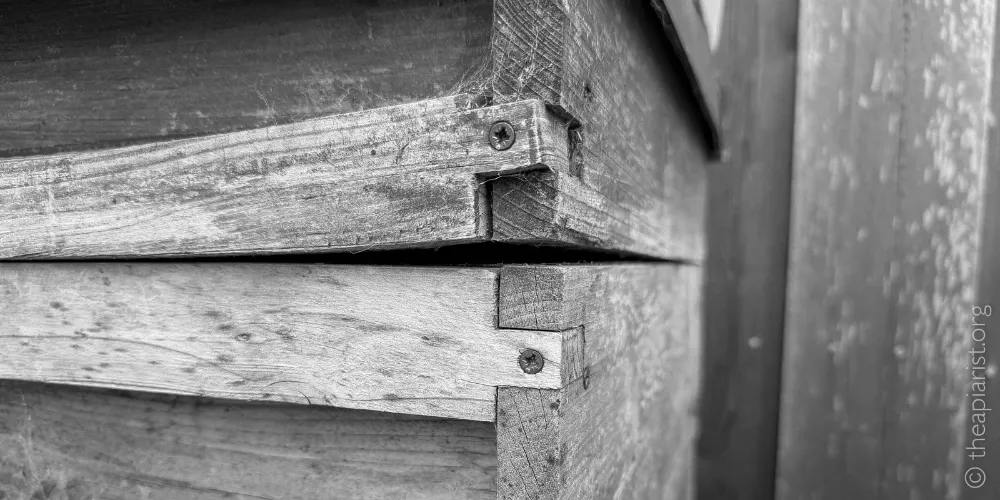
A few cedar boxes might become sufficiently warped that they are no longer 'beetight'. However, this is relatively rare {{2}} and can usually be avoided by constructing them carefully in the first place. Ensure they are built square — ideally on a template — using glue and screws to hold everything together.
I'm still using the cedar hives I started with almost twenty years ago, and they were secondhand when I purchased them {{3}}. Most of my poly equipment is well over a decade old, dating back to the time I expanded from half a dozen hives to ~25.
Painted poly is impervious to just about everything. Indeed, one of the complaints is that it is an environmentally unfriendly material that cannot be recycled.
Avoiding the landfill
'Just about everything', by definition, has exclusions … I can think of three that have affected me:
- Wasps
- Mice
- Gravity
If I lived in Canada I might have to also include bears on this list, but I can only write about things I have experience of.
Over the last few weeks, as I start to tidy things up for the coming winter, I've repaired a few poly boxes damaged by wasps, mice, or gravity. I expect these boxes will be usable for many more years, and are likely to outlast my beekeeping … and probably me.
I thought I'd therefore write about repairing poly boxes this week. Since this barely justifies a thousand words, let alone my usual 23,664, I'll expand the topic to include a couple of other things I've either fixed or improved recently.
The autumn is a good time to deal with these repairs. It's still warm enough to work outside, there's no real practical beekeeping you should be doing, and — if forgotten or avoided — you'll kick yourself next April when you actually need the equipment.
Sponsors get more … posts, news, and information on the science, art, and practice of sustainable beekeeping. It's thanks to sponsors (the paying subscribers) that the lights remain on, and the servers are maintained … without them The Apiarist could not appear every week.
Why not join them?
Build it, don't buy it
If your preferred hobby is racing J-class yachts then the expense involved in buying a couple of WBC hives, a beesuit, and a smoker probably isn't a worry. However, for the rest of us, the relatively high cost of equipment — particularly in the first few years — means that it makes sense to build things if you can.
I've written numerous articles here about DIY for beekeeping, so won't repeat myself.
This equipment also sometimes needs to be repaired, and that provides an opportunity to improve the original design (or marvel at your prescience in getting it right first time 😉).
I'll deal with the poly damage in the reverse order to the list above, and will then discuss repairs and/or improvements to two of my 'homegrown' beekeeping essentials … my hivebarrow and an 'unwobbler' for my extractor. Like the poly hives, these have been used pretty hard for a decade or more, and have recently benefitted from some TLC.