Vexatious viruses

How often have you read the words, “Varroa is the greatest threat to bees and beekeeping”?
If you're a regular reader of The Apiarist then you've read it here, many times.
It's true … up to a point.
However, it's really a convenient abbreviation for a much more wordy explanation of the real threat to bees and beekeeping.
Varroa alone is not an issue, in much the same way as a mosquito is not really harmful.
It's the viruses that the mite or the mozzie transmits that do the damage.
A mosquito bite might be painful, or cause a local immune response {{1}}, but it's only if the mosquito carries dengue or yellow fever virus you're likely to be very unwell {{2}}.
DWV
In the case of honey bees, it's deformed wing virus (henceforth DWV, for obvious reasons) that is the most significant virus transmitted by Varroa.
DWV is ubiquitous, at least as far as honey bees are concerned. There are detectable levels of DWV in all honey bees, including those in regions (such as Colonsay) where Varroa has never been present.
In the absence of Varroa, DWV causes no overt disease, and no apparent problems for either individual bees, or for the colony {{3}}. In Varroa-free colonies DWV is transmitted horizontally during trophallaxis, and vertically (via eggs and sperm) from the queen/drones to the progeny. Under these conditions, DWV levels — the amount of virus per bee — are usually very low.
If Varroa is present, these transmission routes remain functioning in the background. However, when the mite feeds on a developing pupa, it transmits DWV from the last pupa (or adult) bee it fed on.
This transmission route bypasses the usual immune mechanisms that protect the bee (scientists recapitulate this route by simply injecting virus using a syringe). As a consequence, the virus replicates more, and reaches tissues it would otherwise not have access to … where it causes damage.
Virus levels are much higher … perhaps 1–10 million times higher in some pupae {{4}}.
This typically results in one of three possible outcomes:
- The developing pupa dies pre-emergence.
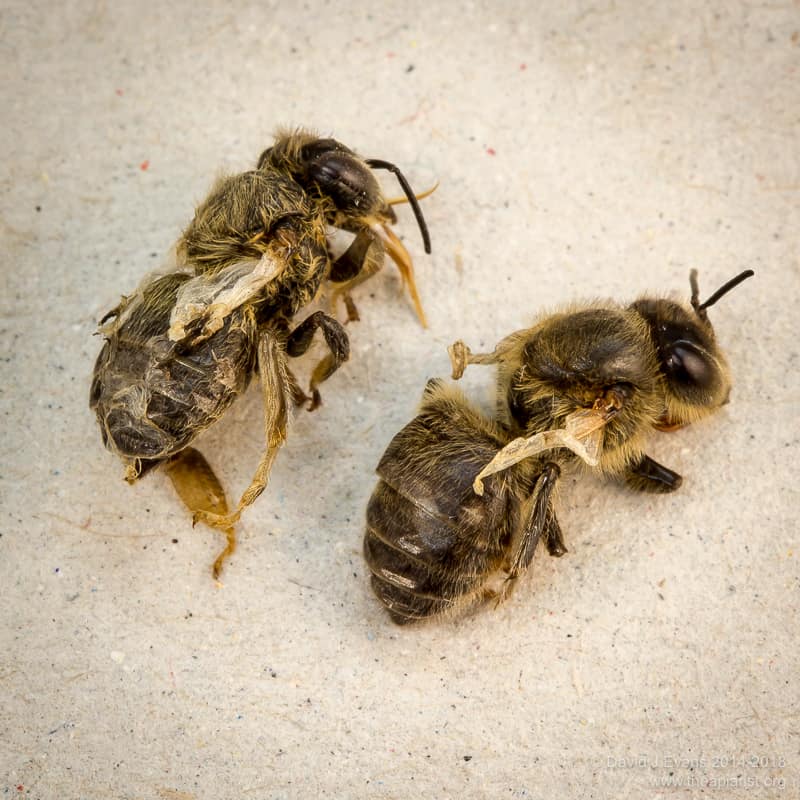
- Developmental defects occur, such as the 'does what it says on the tin' wing deformities {{5}}. The bee emerges, but is unable to contribute to hive activities and is soon chucked out of the entrance where it inevitably perishes.
- The worker {{6}} appears developmentally normal, but is nevertheless severely compromised. Amongst other things, they have impaired learning abilities, lousy communication, poor foraging skills, and — at least in the case of winter bees — a much-reduced lifespan.
And it's the last outcome that accounts for high colony losses. If the numbers of winter bees are significantly depleted before the queen is laying well the following spring, the colony will perish.
So “Varroa is the greatest threat to beekeeping” is both true and false.
It's the viruses that Varroa transmits that are the real threat, but only when the mite transmits them.
Self-amplifying science
Scientific research has a tendency to be self-amplifying.
In the case of viruses, those that cause the most significant disease are often identified first (DWV was identified in 1982 by Brenda Ball and Bill Bailey {{7}}), resulting in follow-up studies that reinforce their importance.
Experimental systems — such as methods to grow or quantify the virus — are developed that make studying the virus a little easier, which facilitates additional studies. More ambitious experiments follow, with additional controls to demonstrate the significance of the results.
And, to ensure continued funding, the science is published.
With more funding secured, the cycle starts again.
At the same time, other research teams start to work on related aspects of the same problem. After all, its important, just look at all the money being spent and publications arising
Inevitably, some results obtained are contradictory … they suggest prior work was incorrect, or misinterpreted {{8}}, or over-interpreted. Other work provides novel insights and justifies further research.
This isn't a bad thing, it's scientific progress. Over time, our understanding (which is what is really important) of the biology of honey bees, mites, and viruses increases. However, it's 'two steps forward, one step back' progress … incremental advances, with lots of back-tracking, repetition and revision.
This knowledge, coupled with empirical beekeeping experience, is what informs our hive management practices … e.g. when and how to minimise Varroa levels.
Having spent part of my career studying DWV {{9}}, I still keep up with the literature.
There have been a recent flurry of DWV/Varroa papers. These nicely illustrate some of this spectrum of scientific contributions — the novel, the over-interpreted etc. I've had a few emails from regular readers about a couple of them, so thought I'd expand on my emailed responses here, rather than repeating myself in the future.
I'll let you decide whether they are interesting, wrong, misinterpreted or truly novel, but I will comment on their relevance to practical beekeeping as the viruses I'm discussing are probably present in all your colonies.