Whose swarm is it anyway? - part 2
As introduced last week, the foulbroods are serious, notifiable, brood diseases. If diagnosed in your bees, their presence will necessitate the destruction of some or all infected colonies.
Devastating for the bees … and the beekeeper.
In the UK, American foulbrood (AFB) outbreaks are at a relatively low level, and — thankfully — slowly decreasing. In contrast, the incidence of European foulbrood (EFB) is either stable or increasing, perhaps due to changes in the dominant circulating strain over the last few years.
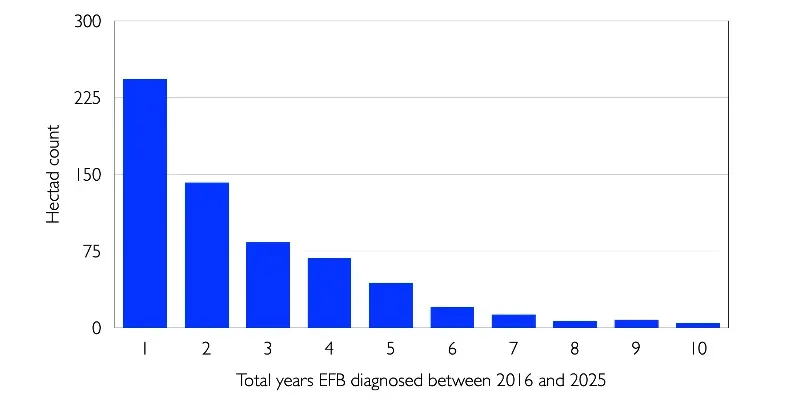
I'll primarily focus on EFB for the remainder of this post, largely because outbreaks are at least 10-fold more frequent than AFB.
However, since the mechanisms of transmission are the same — direct horizontal transmission between bees (e.g. during robbing), indirect horizontal transmission on fomites (inanimate objects that are contaminated e.g. hive tools, smokers or unsterilised boxes), or vertically from a parental colony to a swarm — most of this post also applies to AFB.
As the title indicates, this post is about swarms … specifically, it's about swarms originating from areas where foulbroods are established, or recently introduced. Apiary hygiene and beekeeper-mediated transmission (by moving or purchasing bees from infected areas, for example) are topics for another day.
Endemic areas
In some areas EFB is endemic. It appears every year, often causing multiple outbreaks and numerous individual cases {{1}}. If symptomatic — or, perhaps worse asymptomatic {{2}} — colonies from these regions swarm there is a reasonable chance that the disease will be spread.
If you collect swarms, do cut-outs, or set out bait hives, either to boost your own stocks or to prevent 'lost' swarms from being a nuisance to others, you need to be aware of the risks.
This applies wherever you live. However, it is particularly important if you are in or near a region with foulbrood infections.
In this post, I'm going discuss 'spillover' from hectads in which disease is present, and cover possible options available when collecting swarms from — or near — these areas.
These options include euthanising swarms, rather than risk spreading disease to your bees.
The problem
The following image is an animation showing areas with EFB disease from 2016 to 2025.
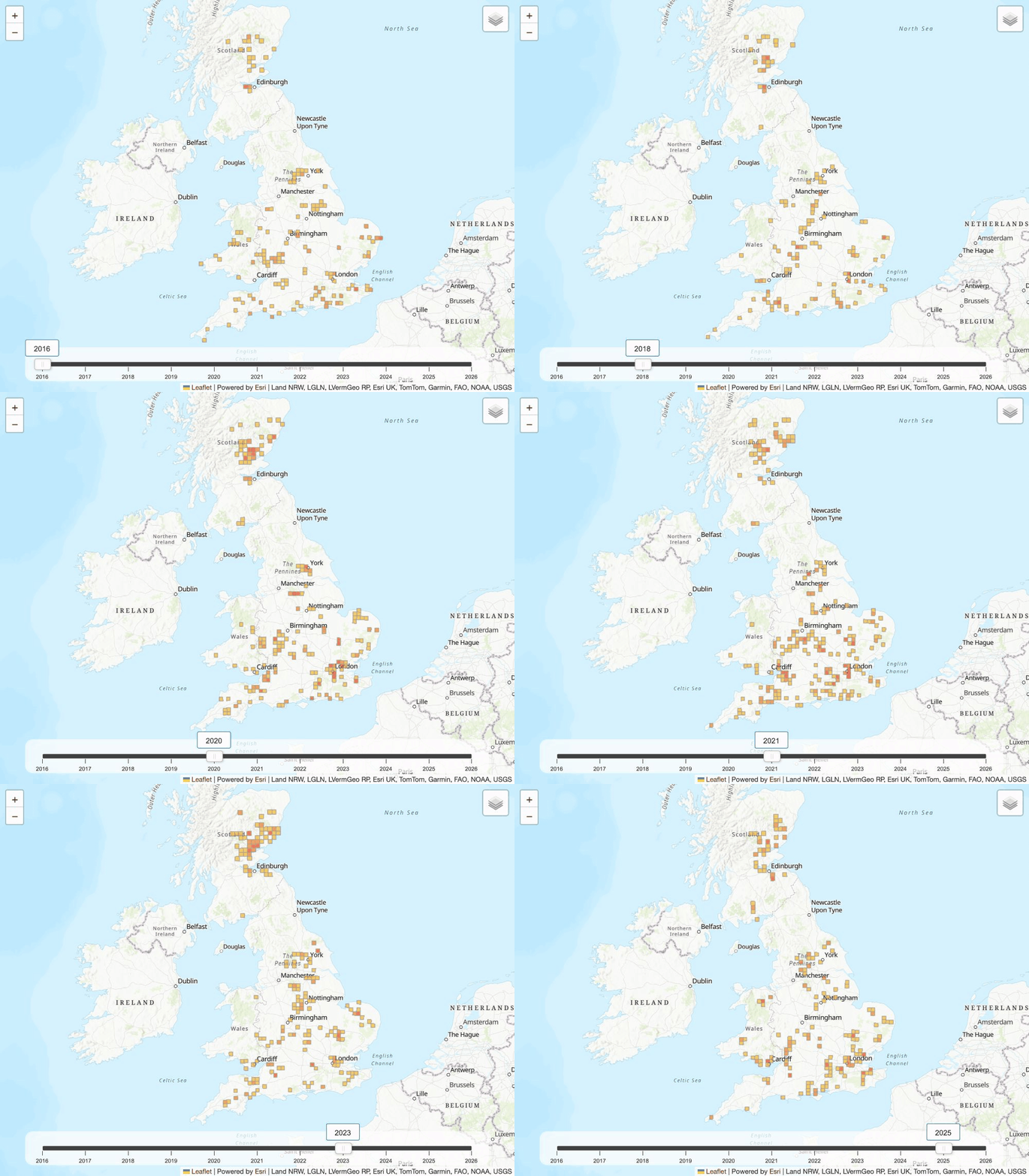
The darker the colouration of individual squares (each is one hectad) the more outbreaks were identified in the year indicated.
Watch carefully … there are several things that are obvious.
- Disease is widespread across much of central and southern England, and eastern Scotland.
- Some hectads 'light up' once and then never reappear. These are pretty randomly located and appear to be sporadic outbreaks.
- A limited number of hectads appear 2–3 times during the decade, either in sequential years, or separated by negative years, but they are generally not surrounded by other coloured hectads in the same or subsequent years.
- A small proportion hectads are (almost) always coloured, some darker than others. These are hectads in which disease is endemic.
- Hectads with endemic disease tend to be surrounded by clusters of other hectads with disease. These may have fewer outbreaks (paler colour) and disease may not be present in every year. Nevertheless, the clusters north of the River Tay, around York, in Norfolk, Kent and east Somerset, are reasonably obvious. Other clusters, albeit less extensive in area or duration, also exist.
If you are within one of these clusters you should be acutely aware of the disease risk in your area already.
If you are adjacent to an endemic hectad, or its surrounding cluster — remember, you could walk from the centre of one hectad to another in about 2 hours, and bees probably forage (or rob) and swarm well beyond the hectad boundary — your bees are at risk.
Why not become a sponsor?
Sponsors receive weekly posts on bees and beekeeping, ~50% of which are for sponsors only. Sponsorship costs less than a coffee and a slice of flapjack a month … or less for an annual membership. This post is only available to paying sponsors.
I specifically stated 'clusters' in the paragraph above. The overspill from endemic areas means that disease may (at least in some seasons) be widespread. Since disease is identified retrospectively, how can you mitigate the risks?
Are you only at risk if you receive a warning email from the NBU? And, if you are at risk, what precautions can you take, and what can you do about swarms of unknown origin? Should you decide to euthanise a swarm, what methods are practical and relatively easy to undertake?