Are slow-release oxalic acid strips the solution?

The solution to what?
The solution to the three-part problem that increasingly faces beekeepers wanting to minimise Varroa mite populations and reduce their winter colony losses.
These are:
- Increasing resistance — and the geographic spread of this resistance — to the 'hard chemical' miticides like Apivar and Apistan {{1}}.
- The inability of oxalic acid (OA) to penetrate the cap on sealed brood.
- The absence of a midwinter brood break in many temperate regions, something which will be exacerbated as the climate continues to warm.
In fact, there may be a fourth part to the problem, the desire of beekeepers to avoid the use of hard chemicals altogether (due both to resistance and the wax-soluble residues they leave behind) in favour of organic treatments.
In the absence of Varroa-resistant colonies, at least two annual miticide treatments are typically required:
- A late summer treatment, applied after the honey harvest and (ideally) before the production of the long-lived winter bees that will maintain the colony until the following spring.
- A midwinter treatment to 'mop up' any mites that survived the late summer miticide, and/or that subsequently managed to reproduce in the small amounts of brood reared in the latter months of the year.
I discuss these, and the importance of timing things correctly, in Rational Varroa Control.
For comparison, I've also previously written about what happens when you use Irrational Varroa Control, applying an inappropriate treatment, at the wrong time, and in the wrong way … don't do this at home (or in the apiary).
The more, the merrier?
I use two treatments a year, but it's not unusual for beekeepers to use different strategies that suit their bees and beekeeping e.g. an application before the spring nectar flow, or in midsummer for colonies going to the heather.
These may be in addition, or instead of, a late summer and midwinter treatment. I know of some beekeepers who use four applications a year, and this may become increasingly common as miticide resistance becomes more widespread.
The problem with additional applications is that they have to be squeezed in between the main nectar flows (as there are no treatments allowed when there are honey supers on the hive {{2}}).
Depending upon where you live, this can prove unachievable … at least if you follow the instructions to the letter on the miticide packaging. For example, the gap between spring and summer nectars is too brief (2–3 weeks) for an application of Apivar or Apistan. During this period the colony will contain lots of brood, making OA ineffective. The best option might be formic acid (and there's just about enough time to complete an application most years) though you risk queen losses, particularly if the weather is hot.
Not least because I'm so poor at predicting when the nectar flows are {{3}} I've stuck to a two application strategy (late summer and 'midwinter' {{4}}) for 10+ years which has worked very well, with winter losses of ~5% over that period.
Forewarned is forearmed
I want to avoid additional treatments, but I also want to be prepared when Apivar-resistance eventually arrives in the UK {{5}}.
In addition, I'm acutely aware of the importance of the timing of the 'midwinter' treatment, and the difficulty many beekeepers have in getting it right.
Since OA does not penetrate sealed cells, the colony must be broodless for this treatment to be effective.
In my experience, 'broodlessness' and 'midwinter' rarely occur at the same time, discussion of which is complicated by the absence of a precise definition of midwinter.
Does it mean midway between the start and end of winter, or the coldest part of the winter?
If it means either of these, then it's almost certainly not the appropriate time for OA treatment.
In my experience, a broodless period — if it occurs at all — happens in very late autumn, or early winter. At my latitude (55° N), I expect my colonies to be broodless sometime in November {{6}}.
But it's not guaranteed.
And, with climate change, these broodless periods will shorten and/or disappear altogether.
Which is why I've followed with interest the development, licensing and use of slow-release OA strips.
Slow- or extended-release OA strips
The principle is straightforward.
OA kills mites by direct contact. Absorbent strips are soaked in a solution of OA and placed in the hive. Typically, the strips are cellulose, the OA solution is prepared in glycerine, and the strips are either hung between, or laid across the tops of, the frames.
Bees moving around the hive contact the strips, and the OA kills any phoretic mites. As new brood emerges, any mites initially present within capped cells transition to the phoretic phase of their life cycle … hopefully to subsequently perish when they are exposed to OA.
The OA is released over a protracted period — the strips remain in place for 42–56 days, covering at least two brood cycles — and published studies have claimed that treatment is temperature-independent.
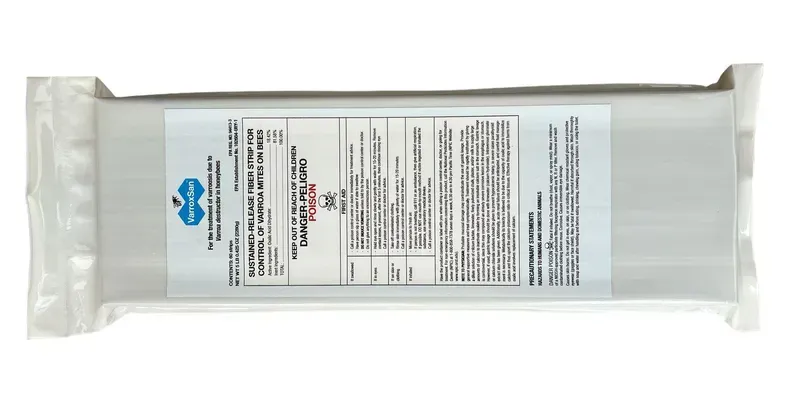
VarroxSan is a commercially-available slow-release OA product from Vita. Studies indicate that VarroxSan kills ~95% of mites, a similar level to that achievable with other effective miticides. When I first discussed it, it was only licensed in the US and Uruguay. It appears now to also be available in Canada {{7}}.
Considering the problems in predicting the winter broodless period and the need to mix'n'match treatments to minimise resistance, perhaps using slow-release OA strips in winter would be an effective strategy to follow a late-summer Apivar treatment?
A recent study has tested exactly this scenario where a commercial beekeeper had experienced increasing Apivar resistance. Two formulations of slow-release OA strips were tested during the winter, and mite levels, colony strength and survival were monitored.
The results, which I found surprising, are relevant to beekeepers where a winter broodless period is not guaranteed.
This post is for paying sponsors only. Sponsors get more … posts, news, and information on the science, art, and practice of sustainable beekeeping. They also have access to over a decade of legacy posts, and their support ensures The Apiarist continues to appear every week.
I'll discuss the results and what I think they mean for practical Varroa management — both with Apivar and OA — and introduce an interesting resource which could help beekeepers identify likely broodless periods in their own colonies.